Preserving the Irreplaceable: How Metalworkers Can Systematize Their Hard-Won Knowledge Before It Disappears
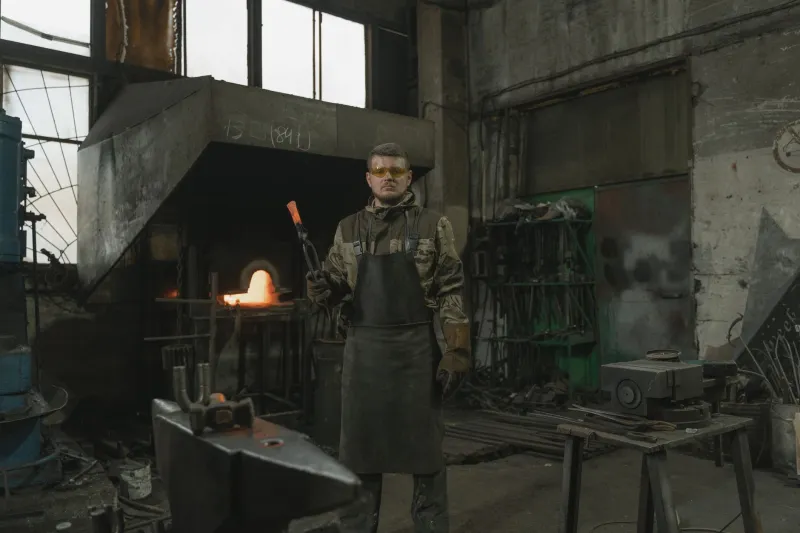
There is a particular kind of loss that rarely makes headlines but costs the American metalworking trades dearly every year. It happens quietly, in the closing of a shop or the retirement of a craftsman who worked alone for forty years. The jigs get sold off. The notebooks—if there were notebooks—get boxed up. And the knowledge that made that shop exceptional, the accumulated intelligence of thousands of hours at the forge or the lathe, simply ceases to exist.
Mastery in metalworking is not abstract. It lives in specifics: the exact quench temperature a bladesmith discovered works better for a particular high-carbon alloy than anything written in the textbooks; the modified grinding angle a machinist developed to extend tool life on interrupted cuts; the sequence of passes a fabricator learned produces flatter welds on thin-gauge stainless. These are not secrets that can be recovered by reading a manual. They are earned through failure, repetition, and the kind of patient attention that only years of practice produce.
And yet, the overwhelming majority of independent metalworkers in the United States have no formal system for capturing what they know.
Why Documentation Feels Uncomfortable—and Why That Needs to Change
For many craftspeople, the idea of documenting their techniques carries an uncomfortable undertone. It can feel like preparing for an ending, or like admitting that what you know might someday need to be explained to someone who wasn't there. There is also the matter of professional identity: knowledge is currency in the trades, and the instinct to protect proprietary methods is entirely reasonable.
But there is a meaningful distinction between protecting knowledge and losing it. A well-constructed archive does not have to be public. It does not have to be shared during your active years. What it does have to be is intentional—built with the understanding that the value of your craft extends beyond your own career.
The shift in perspective that makes documentation sustainable is this: treat your accumulated knowledge as an asset, not merely a habit of mind. Businesses inventory their physical tools. They track their materials. The intellectual capital of a skilled metalworker—arguably the most irreplaceable asset in the shop—deserves the same treatment.
Building a Documentation Practice That Actually Works
The best documentation systems are the ones that fit naturally into the rhythms of existing work. Elaborate archival projects that require dedicated time blocks rarely survive contact with a busy shop schedule. The following approaches are designed to be practical, scalable, and sustainable.
Video Logging at the Bench
A smartphone mounted on an adjustable arm near your primary workstation costs almost nothing and can capture technique in a way that written language never fully replicates. Short, unedited clips of a specific process—the way you grip the hammer for a particular drawing operation, the visual cues you watch for during a specific heat treatment—are more instructive than any written description. The key is consistency: log regularly, label clearly, and store in an organized folder structure with dates and descriptive file names. Over time, this becomes a searchable visual library of your methods.
The Working Journal
A physical or digital journal kept specifically for technical observations is among the most durable documentation tools available. The format matters less than the discipline. What worked, what didn't, and—critically—why you believe that to be the case. Problem-solving entries are especially valuable: when a technique fails and you diagnose the cause, that diagnostic reasoning is often more instructive than the solution itself. Future readers of your notes, whether apprentices or your own future self, benefit most from understanding how you think through problems.
Annotated Shop Drawings and Process Sheets
For metalworkers who work from drawings or repeat similar project types, annotating those documents with process notes creates a reference library tied directly to real work. Notes on material behavior, preferred sequences, tolerances that proved critical in practice—these transform a technical drawing into a living document that captures institutional knowledge in a format already native to the trade.
Structured Apprenticeship Frameworks
For those who bring on apprentices or junior workers, the act of teaching is itself a form of documentation—but only if it is made explicit. Developing a written curriculum, even a rough one, forces you to articulate what you know in transferable terms. The process of explaining a technique to someone who has never seen it frequently reveals assumptions you didn't know you were making, which in turn produces clearer, more precise documentation than working in isolation ever would.
The Emotional Weight of Legacy Work
It would be dishonest to treat knowledge documentation as a purely administrative task. For craftspeople who have spent careers building mastery, the question of what happens to that knowledge after they step away carries genuine emotional weight.
The American metalworking tradition has always been shaped by individuals—men and women who developed distinct approaches, solved problems in unconventional ways, and produced work that was recognizably theirs. That individuality is worth protecting. Documenting your techniques is not an act of vanity; it is an act of stewardship toward the craft itself.
Some metalworkers find that the documentation process also deepens their own understanding. Articulating why a technique works—tracing it back to material science, to geometry, to the physics of heat transfer—often reveals connections that years of practice had left implicit. The knowledge becomes more fully yours in the act of recording it.
Starting Before You Think You Need To
The most common obstacle to documentation is the belief that it can wait—that the right time to begin is after a particularly significant project, or after the shop slows down, or at some future point when there is more space to think carefully about the process. That moment rarely arrives on its own.
The practical advice is straightforward: begin with the most distinctive thing you know. Identify the technique, the modification, or the problem-solving approach that is most specifically yours—the thing that a competent metalworker trained elsewhere would be unlikely to arrive at independently. Document that first. It does not need to be comprehensive or perfectly organized. It needs to exist.
From that starting point, a documentation habit can grow incrementally. One video. One journal entry. One annotated process sheet. The archive builds over time, and what begins as a modest collection of notes becomes, across years, something genuinely valuable: a record of a working mind engaged with its craft at the highest level.
The metal endures. The question is whether the knowledge that shaped it will endure as well. For metalworkers who have spent careers building something worth preserving, that question deserves a deliberate answer.